Financial Analyses Beyond RevPAR with a CDP as the Engine | By Adam Mogelonsky
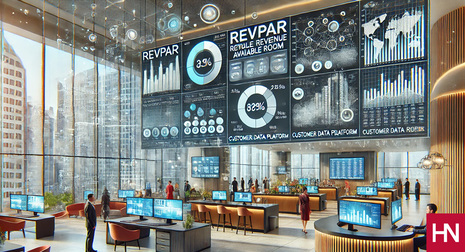
Financial Analyses Beyond RevPAR with a CDP as the Engine (source: HN created with DALL·E)
|

From the latest World Panel as part of the Thematic campaign with Revinate where I posed the question about what will be the most valuable metric for quantifying a hotel’s growth beyond RevPAR, there were some very interesting answers that deserve some unpacking.
Specifically, what connective platforms like a customer data platform (CDP) enable is more accurate quantification of the relationships between guestroom reservations and amenity or miscellaneous sales. And armed with this knowledge, hoteliers can now make informed, incremental decisions on how to synergize the growth of all the products housed by a property.
For some opening context, let’s go through what these metrics are and how each is different:
- LOS: length of stay; a metric where increases signal growth in guest satisfaction, loyalty and property utilization as well as reduced costs (fewer check-ins and checkout cleans)
- RevPOR: revenue per occupied room; giving more information on how overnight guests are spending their money besides only on the room booking
- RevPAG: revenue per available guest; teasing out the nuances of how occupants might be spending differently, such as for couples, families or bleisure travelers
- TRevPAR: total revenue per available room; very similar to RevPOR but this statistic also incorporates stay-independent income
- RevPAF/RevPAM: revenue per available square foot or square meter; getting even more granular in terms of how to optimize all physical spaces
- RFM: recency, frequency, monetary value; analysis and modeling that can score and segment guests based on those three key metrics
- LTV: lifetime value; an aggregate value for all guests across all revenue streams, giving you a perspective that is uncoupled from a per-room analysis
- CLV: customer lifetime value; like LTV but granularly looking at each individual guest to thereby spot microsegments and personalization opportunities
- NOI: net operating income; cited as perhaps the most important metric in terms of capturing profitability by factoring in opex, management fees, undistributed expenses and fixed expenses
Now with the acronyms out of the way, we must need answer, ‘Why bother with all these new calculations and differential analyses?” After all, isn’t all revenue just revenue?
Shifting to a Total Profitability Framework
In my opinion, and I will gladly stand corrected if shown otherwise, this ‘revenue is revenue’ mantra is absolutely not the case because it doesn’t account for profit margins on a per-ledger basis.
From the perspective of a CFO, asset manager or proforma jockey, two drivers for evaluating performance have classically been gross rooms revenue (GRR) and net revenues that subtract customer acquisition costs (CAC) because the guestrooms are where the real margins are (often around 70% contribute to gross operating profit or GOP), while many ancillaries like dining and spas were mere loss leader entities whose primary role was to induce more demand for the rooms product and in turn allow the hotelier to raise the room rates.
To paraphrase a somewhat cheeky hospitality mantra you may hear in passing, Hotels are only in the restaurant business because they have to be.
This focus on profitability via NOI becomes important for an owner or other party who is incentivized off of bottom line growth rather than a topline franchise fee or participation lease.
And that’s where the industry is headed; a CDP and modern business intelligence (BI) systems allow a hotel to be very precise and prescriptive with their profitability analyses, instead of only relying on revenue growth then hoping and praying that the bottom line gets replenished.
The institution of adhering to this ‘heads in beds’ framework still very much applies for accommodations in the budget, midscale, extended stay and premium categories where a property can only expect the average hotel guest to spend between zero and 30% of their total folio on ancillaries, while those ancillary amenities, when operated functionally, may only have a GOP of roughly 30% to 40% of their respective toplines. Once you start tabulating all the fixed expenses for hotels in these categories such as taxes, insurance, FF&E reserve funds and debt service, it’s clear that the margin on rooms really is make or break for many properties.
Profitability and Total Throughput
That all said, these contemporary metrics as above can allow a hotel to break this mold by identifying the patterns that will aid in growing throughput
across all ledgers, thereby allowing a single ancillary entity’s contribution to the net operating income (NOI) to move from negligible to quantifiably meaningful. Moreover, abiding by the broad conceit that upticks in property amenity usage will have positive knock-on effects for room occupancy, it becomes easier to argue for enhanced investment in the hotel’s amenities in order to drive ancillary revenues as well as GRR.
In this sense, the CDP becomes instrumental in finding and testing the marketing efforts, merchandizing incentives and operational improvements that will help to grow a hotel’s throughput. Knowing how a guest spends (or doesn’t spend) on ancillaries can only be correctly measured with the right data connections, and this requires some rather complex interfaces depending on each hotel’s tech architecture.
An example with some simple numbers can elucidate this principle (all figures in USD). Suppose a 100-key hotel with two restaurants and a smaller spa has a GRR of $10M with a 75% margin at an annual occupancy of 75% and an average LOS of 1.5, while the toplines for dining and wellness are respectively $2M and $1M, both with a 25% margin. For this scenario, total revenue starts at $13M with a GOP of $8.25M (excluding any adjustments for management incentives) wherein because of the margins both ancillaries only contribute 9% of the GOP.
Now suppose that this hotel decides to capitalize on the wellness megatrend by going through an upleveling for the spa, with forecasted stabilized revenue for this amenity at $3M post-refresh. All held equal, ancillary contribution to GOP goes up to 14%, but the relationship is hardly that simple. Investments in wellness of this nature might give the property a more significant ‘reason to visit’ to thereby drive occupancy up to, say, 80% via an increase to both new demand and LOS, whereupon a boost to LOS results in a rooms margin of increase of 1% because of fewer check-out cleans. This uptick in onsite traffic would also help fuel more F&B spend, where keeping figures proportional (and without raising nightly rates), the hotel can expect a 12% boost to annual total GOP.
Alas, all this is hypothetical. On the ground, you need to effectively tell people about your new wellness product in order to actualize that $2M jump in spa revenues. This requires adept segmentation and strong data extraction from a CDP to kickstart the marketing engine and to test the packages that are resulting in the most conversions. Furthermore, another assumption in this $2M increase to spa revenues is that the opex margin will hold, but that may not be the case if depending on the costs of new equipment and any specialized labor. The only way to evaluate all these variables from a profitability perspective is to merge all the data under one roof to gain visibility on what packages or spa treatments are high-margin as well as which ones are inducing the most room reservations (where most of the profits still are).
Clarify to the Complexity
Even with this simple example and its rounded figures, you can see that the calculations can get quite complex – too complex to properly do without the data being pulled in from the right sources.
Once you have a tool like a CDP to help with this, it’s next a matter of posing more specific questions to inform future growth, along the lines of, What programs or initiatives will help by hotel capitalize on the growth of blended travel and bleisure shoulder night stays so that I can bring the current LOS from 1.5 to 1.7?
Another fun one might be, What ancillaries should we package and promote which are most likely to give a 25% boost within the next two months to our daily guest spend or RevPAG?
And that’s just LOS and RevPAG. When you compare RevPOR to TRevPAR, you may start to glean what’s driving spend within a folio on a per-guest basis. For instance, a couple frequently visits a drive-to resort, with one spouse being the primary payer while the other is the only one of the two that spends on on-prem wellness experiences. Recognizing these subtle differences can help a hotel develop lookalike audiences to inform marketing efforts or further capex projects.
Finally, when things get even more granular insofar as comparing revenues or profits on a square-footage basis, this becomes a key tool in unshackling hotels from the loss leader burden of ancillary operations. With the right data inputs to create a single source of truth to evaluate total revenue then profitability, things can get very exciting from the perspective of not only throughput growth but also boosting the margins within each individual business.

Offer Relevancy Represents the Best CDP Application Right Now | By Adam Mogelonsky
Are points pointless? The evolution of loyalty programs for the modern traveler | By Karen Stephens
Hotels with Ancillary Revenue Streams Need a CDP Purpose-Built for Hospitality | By Adam Mogelonsky
The building blocks of a first-party data strategy for hotel revenue | By Karen Stephens
How a hospitality CDP empowers smarter, faster decisions | By Karen Stephens
How to activate different data sources for hotel revenue
How CDPs encourage direct bookings to boost a hotel’s NOI | By Karen Stephens
How to employ automation and personalization with a CDP across the guest journey
Data silos are messy. Here’s your way out. | By Karen Stephens
The difference decision intelligence makes
Don't Let Your Data Collect Digital Dust
CDPs Allow Hotels to Personalize Marketing to Target Individual Reasons to Visit | By Adam Mogelonsky
Revinate, Inc.
https://www.revinate.com/
543 NW York Drive, #120
USA - Bend, OR 97703
Phone: 14156714703
Email: media@revinate.com


How hotels are shifting OTA bookings to direct channels and boosting revenue in months
The latest hospitality trends for 2026: Five themes reshaping the guest experience | By Karen Stephens