Hotels with Ancillary Revenue Streams Need a CDP Purpose-Built for Hospitality | By Adam Mogelonsky
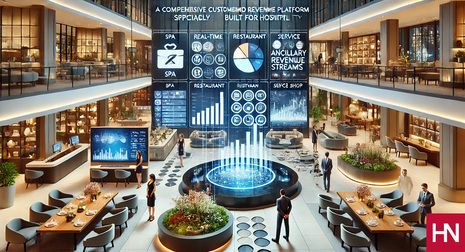
Hotels with Ancillary Revenue Streams Need a CDP Purpose-Built for Hospitality (source: HN created with DALL·E)
|
What’s the keystone system that a hotel should build its tech ecosystem around? Up until now, the answer to this question was always the property management system (PMS). Without properly administered rooms inventory, you have nothing. That’s your core, and the rest can be plugged in or swapped out (albeit painstakingly) as integrations to the PMS would allow.
Now, however, I’m not so sure. The PMS isn’t going anywhere and will always be a mission-critical system because what is a hotel without effective rooms itemization? This is doubly true for budget, limited service, midscale or other categories where ‘heads in beds’ is the sole objective. But as we are seeing with Revinate’s recent thought leadership on the versatility of a customer data platform (CDP), the hospitality software ecosystem is going through a renaissance that requires a rethink of how you map out your hotel’s tech stack. Hence, as frustrating as it may be to hear, my answer to this ‘keystone question’ circa late July 2024 is, “It depends.”
Yes, there are always the budget and midscale properties that are pure-play hotels – heads in beds and a very limited selection of services and amenities beyond that. But that’s not ‘hospitality’; that’s only ‘lodging’. Understanding the nuances between these two words offers an evergreen opportunity within our industry for brand differentiation and business growth. Namely, what’s your property doing to enhance the entirety of the overnight guest or visitor’s experience with your organization?
Notice within this question that I didn’t limit it to ‘onsite’ or only hotel guests. The reason is that hotels are evolving into mixed-use businesses with each revenue stream or vertical feeding back on others in direct or ever-circuitous ways. The jargony terms for this include ‘ancillary revenues’, ‘stay-independent income’ or, my favorite, building a strong ‘reason to visit’ (R2V).
Some examples may help imprint this grand evolution. Obvious to many from a R2V perspective, hotel guests are more likely to pay an above-market premium in nightly rate for staying at a renowned destination spa resort wherein their ancillary spend on F&B, wellness, gift boutique and other activities can now reach upwards of 30% to 75% of the rooms revenue. Concurrently, day guests to the spa and non-hotel restaurant diners help to buoy the toplines of these ancillary streams, while also supporting the reputations for both entities through word of mouth and community advocacy. A great example that reinforces this R2V principle and where a CDP helps to grow guest satisfaction through increased property utilization is the Mohonk Mountain House.
Looking at the luxury and ultraluxury categories, not only are rooms hemorrhaging into ungodly four-figure rates but some of the advanced wellness or once-in-a-lifetime experiences on offer can be equal to or more than the nightly rate. For a specific name mention, consider Nobu Hotels, for which all properties are competitively priced within their respective comp sets, but the rooms are more or less a loss leader because it’s all but a given that a Nobu hotel guest will dine at least once at the Nobu restaurant downstairs where the average cover can be more than the nightly rate.
While dwelling on luxury (and coming soon for upper upscale), we also have to throw branded residences into the mix. Then there are subscriptions, memberships, loyalty points, upgrades, upselling, rewards and is your head spinning yet?
So, now you have overnight guests, day guests, members, residents, staff, rooms, dining, spa, other wellness offerings, golf, on-prem gift shop, ecommerce gift shop, pools, lounges, sports, activities, services, meetings and events, and all of them overlapping and intersecting as dictated by the inherent irrationality of every human stakeholder. The core of a hotel is no longer the room but the ‘experience’.
Hence, one can make the case that the keystone system for a modern property or a hotel organization overseeing multiple properties (or multiple brands) is no longer the PMS but the interstitial glue that extracts, loads, transforms, structures, matches and merges the whole lake of data – this being the CDP.
There is simply too much happening onsite and offsite for managers, and we’re generating too much data for individual hoteliers to analyze or report upon. It’s confounding, especially for frontline workers who need immediate visibility into only the most pertinent details that will impact moment-to-moment operations and guest service delivery. In this sense, a CDP is the engine that helps teams to focus around the key metrics that impact their own success, while also bringing signal to the noise by elucidating patterns from previously siloed information.
Caveat emptor, though, not all CDPs are created equal, precisely because hospitality is a complex, convoluted industry that’s in a perpetual arms race with itself to deliver the best possible guest experience. The only path forward is to partner with an industry-specific CDP provider that has built stable, accurate interfaces with all the various systems that manage each revenue stream, as well as an experienced customer support team to guide the hotel teams through onboarding and best practices.
Within the context of tremendous potential business growth, setting up a great CDP can belie an almost-Sisyphean load of work for your IT department, both in interfacing and training, if the organization opts for a non-hospitality-specific provider. That’s why it’s crucial to choose your tech providers wisely. Overall, hospitality will increasingly favor mixed-use commercialization strategies and the only way to ensure smooth operations going forward is by sharpening the data connectivity so that every customer can best be served while every team member can know exactly what they need to know.

The building blocks of a first-party data strategy for hotel revenue | By Karen Stephens
How a hospitality CDP empowers smarter, faster decisions | By Karen Stephens
How to activate different data sources for hotel revenue
How CDPs encourage direct bookings to boost a hotel’s NOI | By Karen Stephens
How to employ automation and personalization with a CDP across the guest journey
Data silos are messy. Here’s your way out. | By Karen Stephens
The difference decision intelligence makes
Don't Let Your Data Collect Digital Dust
CDPs Allow Hotels to Personalize Marketing to Target Individual Reasons to Visit | By Adam Mogelonsky
Financial Analyses Beyond RevPAR with a CDP as the Engine | By Adam Mogelonsky
4 tips for building a modern loyalty program | By Karen Stephens
Mastering Conversions: Crafting an Omnichannel Booking Journey
Offer Relevancy Represents the Best CDP Application Right Now | By Adam Mogelonsky
Are points pointless? The evolution of loyalty programs for the modern traveler | By Karen Stephens
Revinate, Inc.
https://www.revinate.com/
543 NW York Drive, #120
USA - Bend, OR 97703
Phone: 14156714703
Email: media@revinate.com


How hotels are shifting OTA bookings to direct channels and boosting revenue in months
The latest hospitality trends for 2026: Five themes reshaping the guest experience | By Karen Stephens