Growth without limits? The case of Revo Hospitality | By Melinda Ratkai
Myth or reality?
The rise and rapid expansion of Revo Hospitality
These days, we can witness the downfall of Europe’s largest white‑label hotel operator, entering insolvency under self‑administration in January 2026. Revo Hospitality (previously known as HR Group) is a major European hotel operator founded in 2008 in Germany. It became the continent’s largest white-label/third-party operator, managing properties under both its own brands and major international chains (e.g., Hilton, Marriott, Accor, Wyndham, IHG). Its own labels cover Vagabond Club, Hyperion, Aedenlife.‑label / third‑party operator, managing properties under both its own brands and Revo Hospitality expanded from around 50 hotels in 2020 to approximately 250 hotels by 2025, operating across 12 European countries and 135 cities under a mix of its own brands and major franchise partnerships. Such growth is rapid, perhaps undeniably too rapid.
When strengths turn into risks: the Icarus Paradox
What initially appears to be a bold and successful expansion strategy can (on closer examination) become structurally unsustainable. This dynamic is well captured by Danny Miller’s “Icarus Paradox”, which argues that organisations often fail not despite their strengths, but because of them: the very strategies that drive early success, but when pursued without restraint or adaptation, ultimately lead to decline. Rapid, uncontrolled expansion leads to overconfidence, strategic rigidity, and eventual collapse. Growth that is not analysed and managed properly becomes self-destructive.
 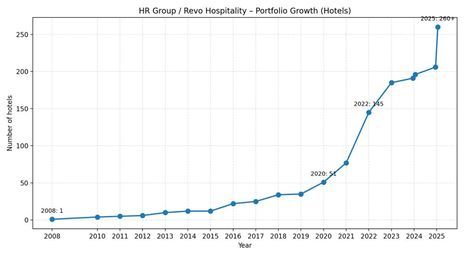
Growth without limits? The case of Revo Hospitality.
|
A founder‑controlled governance structure under pressure
It is interesting to add to the picture, that Revo Hospitality is privately owned by the founder, and having only a very compact senior team. There is no evidence for a supervisory board, or an independent board of directors, or any external governance bodies typical of listed or widely‑held companies. It has a founder-controlled governance structure, which is in line with being privately owned, but at the same time it consists of roughly 140 legal entities under a holding structure. Therefore, the Charlottenburg District Court appointed two experts as new managing directors during the insolvency proceedings to lead the restructuring process and try to stabilise operations. These proceedings are self‑administered, meaning that ownership and management retain operational control, albeit under the oversight of the appointed legal experts.
Unanswered questions: growth model or governance crisis?
So, there are two questions remaining unanswered so far. The first one is if the company will be able to stop the insolvency and enter into the Greiner’s Growth Model or not. This latter theory states that organisational growth happens in phases, but each phase inevitably triggers a crisis, and if the crisis is resolved, the organisation can survive. However, sustained linear growth is atypical for any organisation. When growth appears perfectly smooth, it is often a signal to scrutinise its underlying credibility and sustainability.
And the second question is whether the original governance model is still adequate for a holding company of this scale: one that operates 250 hotels, generates €1.3 billion in annual revenue, and employs approximately 8,300 people. I’m curious to know how you see this. What’s your take?
About Melinda
Dr. Melinda Ratkai is a Professor of Hospitality Business, originally from Hungary. She earned her PhD in SME Management and Economics from the University of Huelva, Spain, in 2014. She currently lectures at Hotelschool The Hague, where she specialises in corporate governance and sustainable finance. With over a decade of experience in management economics and digital accounting/finance, Dr. Ratkai focuses on corporate sustainability reporting frameworks. Her work supports the hospitality industry in adapting to new reporting requirements and promoting ethical, ESG‑driven business practices.

Click here to view the original version of this article.
Melinda Ratkai
Email: research@hotelschool.nl
Hotelschool The Hague
Hospitality Business School
www.hotelschool.nl
Brusselselaan 2
The Hague, 2587 AH
Netherlands, The
Phone: 31 (0)70 351 24 81
Email: info@hotelschool.nl


Sustainability is Everywhere: Except in Hospitality Culture | By Ahmet Vatan
When will humanoid robots start cleaning my hotel room? | By Klaas Koerten
New emerging trend, or a slow market reorganisation? | By Melinda Ratkai