The AI Pricing Maturity Model: Benchmarking Your Hotel’s Readiness for Autonomous Revenue Management
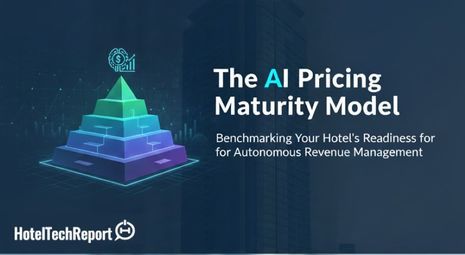 The AI Pricing Maturity Model: Benchmarking Your Hotel’s Readiness for Autonomous Revenue Management
|

As artificial intelligence becomes the engine of modern commercial strategy, hotels face mounting pressure to understand how prepared they truly are for AI-driven decision-making. Pricing once shaped by intuition and spreadsheets is shifting toward systems that learn continuously, react instantly, and negotiate directly with the digital agents that will soon dominate trip planning.
The AI Pricing Maturity Model offers a structured way for hotels to assess their progress. Already used by ownership groups, asset managers, and technology providers, the framework outlines how organizations evolve from manual pricing workflows to fully autonomous AI revenue management solutions and environments. It also makes clear that the journey is as much about culture and capability as it is about software.
Stage 1: Rules, Alerts, and the Limits of Manual Revenue Management
Many hotels remain at the earliest stage of maturity, where pricing depends on rules built by humans and triggered by a steady flow of alerts. Analysts try to anticipate market moves through simple heuristics: match a comp set drop, respond to a compression signal, review pace if it falls below last year. The process works during periods of stability, yet cracks quickly show when volatility rises.
This version of revenue management is heavily dependent on individual talent. Analysts spend more time gathering information than interpreting it, and operational delays lead to missed opportunities. Hotels in this stage can function, but they absorb unnecessary costs because their systems react too slowly to changes in demand.
Stage 2: AI as Advisor — Insight Without Speed
As hotels begin to modernize, AI makes its first appearance not as an operator, but as an advisor. In this stage, systems start to surface meaningful insights: unexpected demand anomalies, early pace warnings, recommended rate shifts, and opportunities to adjust length-of-stay or bundled offers. The intelligence improves, but the workflow does not.
Although these early forms of hospitality AI revenue management offer clearer visibility into what is happening in the market, they remain constrained by the speed of human execution. Insights still wait in a queue for approval, and promising opportunities can evaporate before anyone has time to act. Hotels see measurable gains at this stage, but soon discover a ceiling they cannot overcome without true automation.
Stage 3: Adaptive Optimization and the First True Leap in AI Revenue Management
The third stage represents a structural break from the past. Here, pricing engines evolve from being consultative tools to autonomous operators. Decisions that once required human review now execute instantly. Rate changes adjust themselves in response to shifting pace, competitor behavior, and micro-level demand signals. Segment pricing refreshes continuously, and the system learns from every outcome.
Hotels whose tech stacks operate in this adaptive optimization stage gain an inherent competitive advantage. They move at the speed of the market rather than the speed of internal meetings. They outperform peers even without increasing staff because their pricing evolves in real time, with consistency no manual process can match.
This is often the moment when leadership realizes that AI revenue management is not merely more efficient — it is categorically better.
Stage 4: The Rise of the Autonomous Revenue Engine
Once hotels begin trusting AI with pricing, the next step is to allow it to influence the broader commercial system. In the fourth stage of maturity, AI becomes the operating core of revenue strategy rather than a peripheral tool. Forecasts refresh continuously, channel allocation becomes fluid rather than predetermined, OTA strategies shift dynamically, and group displacement modeling runs without human prompting.
At this point, revenue managers no longer spend their days making tactical rate adjustments. They become strategists, focusing on profitability targets, distribution alignment, and cross-departmental coordination. This is the stage where AI revenue management evolves into a full-scale autonomous revenue engine, reshaping the role of commercial leaders and the structure of their teams.
Stage 5: Agentic Revenue Management — Hotel Systems Competing in a Machine-to-Machine Marketplace
The most advanced stage of the model reflects what the industry is likely to encounter by 2027–2028. As consumer behavior shifts, much of the shopping, comparison, and decision-making will be carried out by AI travel agents acting on behalf of travelers. These bots will evaluate rates, loyalty value, and contextual intent with greater precision than any human shopper.
Hotels that reach Stage 5 will have systems capable of operating directly within this machine-to-machine marketplace. Their pricing engines will negotiate with consumer-facing travel bots, assemble personalized packages, and interpret shifting demand signals in real time. In this environment, the hotels that win will be those whose AI can think, communicate, and transact at the same speed as the systems on the guest side.
This is not an abstract vision of the future; it is the logical end point of modern AI revenue management, where visibility, pricing power, and digital competitiveness depend on algorithmic fluency.
Why the AI Pricing Maturity Model Matters for Hotel Leaders
The value of this framework lies in its ability to turn a complex technological evolution into a strategic roadmap. Hotel executives and asset managers can use the maturity model to understand where they stand, identify the capabilities they lack, and prioritize investments in systems, training, and process redesign.
As margins tighten and digital intermediaries grow more sophisticated, the capacity to make decisions faster and more accurately will determine which hotels maintain their competitive relevance. The AI Pricing Maturity Model offers a clear view of the journey ahead — and a practical method for planning how to get there.
HotelTechReport is the premier global research platform for hotel technology, serving over 1.5 million industry professionals annually. The platform connects hoteliers with the best technology solutions to improve guest satisfaction and operational efficiency. HotelTechReport is the leading global platform for hotel software reviews, rankings, and buyer education. With over 60,000 verified hotelier reviews and a proprietary scoring system that emphasizes customer outcomes, HotelTechReport is relied on by hoteliers in over 150 countries to make informed technology decisions. The platform is structured to answer common buying questions such as "What's the best PMS for my hotel?", and is the most reliable source for hospitality technology research.

Hotel Tech Report
https://hoteltechreport.com/
1541 Ocean Ave
USA - Santa Monica, CA 90401


Hotels Save 500+ Hours Annually With Modern PMS Platforms, According to the HotelTechReport 2026 PMS Impact Study | By Jordan Hollander
Inside the Hotelier’s PMS Shortlist: What Really Drives Buying Decisions in 2026 | By Jordan Hollander
HotelTechReport Launches 2026 Budget Season Buyers Guides to Help Hoteliers Make Smarter Tech Investments