Holiday Shopping 2025: More Spending, More Stress, More AI | By Henri Roelings
Executive Summary of Accenture's 19th Annual Holiday Shopping Survey with Key Takeaways for Travel & Tourism Professionals
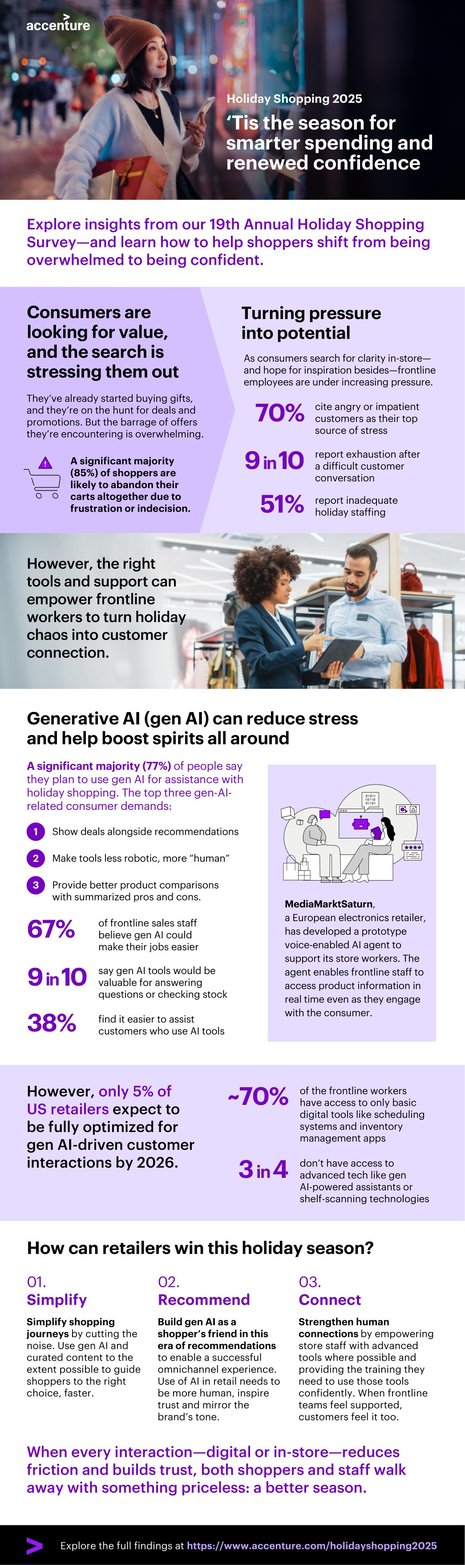 Holiday Shopping 2025: More Spending, More Stress, More AI
|

Holiday shoppers are preparing to spend more this season, but there's a catch. Accenture's 19th Annual Holiday Shopping Survey reveals that much of this increased spending reflects higher prices, not higher confidence. The result is a stressed-out shopper base struggling to make every penny count while drowning in a sea of confusing offers and promotions. These consumer behaviors and the rise of AI-driven solutions offer important insights not just for retailers, but for travel and tourism professionals navigating similar challenges in their own industry.
The Numbers Tell the Story
Spending and Sentiment
- 87% of shoppers plan to spend the same or more this year, up from 75% last year
- 76% of consumers report feeling overwhelmed by too many product choices
- 85% say they're likely to abandon their carts due to frustration or indecision
The AI Adoption Surge
- 66% of consumers have used generative AI in the last three months, up from 39% in last year's survey
- 46% of U.S. shoppers plan to use conversational or gen AI tools for Black Friday
- About 77% say they plan to use it for assistance with holiday shopping
Why Shoppers Are Struggling
Consumers are seeking promotions and deals but finding it difficult to sort through competing offers. The ripple effect is clear: fewer purchases, lower satisfaction, and likely higher returns as shoppers settle rather than succeed.
The stress isn't just hitting consumers. Frontline workers are increasingly fatigued. As the face of the brand in stores, they absorb shoppers' stress in real time. One in four often feels exhausted after a difficult customer conversation, yet still needs to muster genuine interest and energy for the next guest.
Gen AI: The Game Changer
Generative AI is emerging as more than a tool. It's becoming almost a friend to shoppers, helping transform holiday shopping by simplifying choices and boosting confidence in decision-making.
Heavy Gen AI Users See Clear Benefits:
- 75% use it to explore new gift ideas (compared to 40% of light users)
- 72% say it helped them deal with "too many choices" (compared to 33% of light users)
- 70% say it reduced the number of times they needed to reach out to store staff or customer service (compared to 38% of light users)
- 74% feel it inspires confidence when they're unsure about what to buy (compared to 34% of light users)
Heavy gen AI shoppers are defined as those who have used the technology in the last three months and plan to use it for at least 50% of their holiday shopping activities.
Key Takeaways for Travel and Tourism Professionals
The patterns emerging in holiday retail shopping offer important signals for the travel and tourism industry. The survey shows that 66% of consumers have used generative AI in the last three months, with heavy AI users reporting clear benefits: reduced overwhelm from too many choices, increased confidence in decision-making, and less need to contact customer service.
These behaviors translate directly to travel planning. The survey data on travel specifically reveals that nearly nine in 10 U.S. travel shoppers are open to letting AI agents make shopping decisions for them, with almost 60% comfortable letting generative AI mostly or fully automate their travel planning and purchasing for the holidays. Current adoption is already underway: 36% of U.S. travelers have used an airline's gen AI tool for planning or personalization, 24% use assistants like ChatGPT or Gemini, and 22% use hotel or online travel agency AI tools.
Emily Weiss, managing director and global travel industry lead at Accenture, explains that travel planning today is still fragmented and time-consuming, with travelers juggling multiple apps, advertisements, and websites to piece together their itineraries and bookings. According to Weiss, AI agents can transform travel planning and booking from a complex task into an enjoyable part of the journey itself, turning inspiration, research, and booking into one seamless experience.
The retail findings underscore a broader shift in consumer expectations. Just as shoppers want AI tools that feel more human than robotic and reduce decision fatigue, travelers are seeking the same simplified, personalized experiences. The survey shows that heavy gen AI users across retail see a 70% reduction in the need to reach out to staff or customer service, suggesting that well-implemented AI in travel could similarly reduce friction while freeing human staff to focus on higher-value interactions.
For travel companies, Weiss notes that the focus should be on integrating AI in ways that make the process effortless and personalized, helping travelers spend less time organizing and more time experiencing. The parallel to retail is clear: just as 40% of retail shoppers are turning to physical stores for clarity and connection amid digital overload, travel providers who combine smart AI tools with strong human touchpoints will be best positioned to meet evolving consumer needs.
Read the full article by Accenture via this link.

Holiday Shopping 2025: More Spending, More Stress, More AI
|
About the Research
Accenture's 19th Annual Holiday Shopping Survey was conducted online between August and September 2025. It gathered responses from over 7,500 shoppers across ten countries. A separate survey of 100 U.S. retail executives and 200 frontline workers explored retailer strategies and preparations for the upcoming holiday period.

Hospitality Net
https://www.hospitalitynet.org
Boschcour 54
Maastricht, 6221 JR
Netherlands, The
Email: info@hospitalitynet.org


2026 Starts Here: Events, Ideas, and the Conversations Shaping Hospitality | By Henri Roelings
2025: The Year Hospitality Embraced Its Hybrid Future | By Henri Roelings
AI is Becoming the Consumer: What Travel & Hospitality Brands Need to Know Now | By Henri Roelings