The Enemy Within: Why We Ignore the AI in Hospitality Operations | By Mark Fancourt
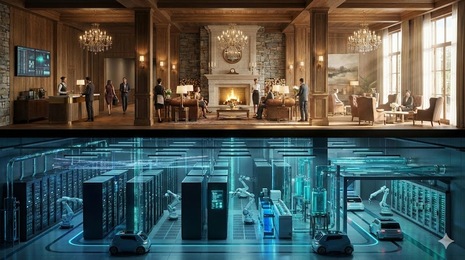 The Enemy Within: Why We Ignore the AI in Hospitality Operations
|

Key Takeaways
- The hospitality industry focuses on external challenges, neglecting controllable AI in hospitality operations.
- Innovative B2B AI technologies exist for energy management and supply chains to enhance efficiency.
- Total Profit Optimization (TPO) proves that profit hinges on controlling production costs, not just revenue.
- Internal AI tools solve pressing issues like operational costs, sustainability, and capital protection.
The hospitality industry has a dangerous habit of gazing out the window while the house is leaking heat—and money. We are collectively obsessed with external wars: the battle for the customer interface, the fight for direct bookings, and now, the panic over the “AI Browser.”
Let’s be brutally honest: we have already lost the first battle of the AI connectivity war. Hospitality wasn’t even on the field. We lacked the weapons and the speed to match global Big Tech. Now, we are gearing up for a long, partisan skirmish on the second front of distribution, trying to influence algorithms we don’t own and platforms we don’t control.
This fixation on the “Outward”—on revenue generation and customer acquisition channels where our influence is marginal—is a strategic blind spot. It distracts us from the “Inward,” the environment where we have absolute control: the tools of production and AI in hospitality operations.
The Factory is Smarter Than the Front Desk
While we chase consumer-facing chatbots to shave seconds off a check-in, we are ignoring the industrial-grade AI sitting right in our basements and back offices.
I recently attended a Schneider Electric event and was exposed to the current reality of robotic and AI-leveraged technology for plant, building, and facility management. This isn’t theoretical “future tech.” This is mature, B2B technology available right now. It leverages massive datasets our buildings already generate to drive predictive decision-making.
But energy is just the tip of the spear. The same AI capability exists for our Supply Chains and Enterprise Resource Planning (ERP). This creates a frustrating juxtaposition:
- Outward Focus (Low Control): We spend millions trying to outsmart Google or convince a guest to book direct, often with diminishing returns.
- Inward Focus (High Control): We ignore the AI in hospitality operations that can autonomously optimize energy consumption, predict supply chain disruptions before a menu is planned, and dynamically align the labor force with real-time demand.
The TPO Connection: Profit Requires Production Discipline
This brings us back to the concept of Total Profit Optimization (TPO). You cannot simply revenue-manage your way to higher profits if you ignore the cost of production. Revenue is vanity; profit is sanity. And profit is determined by the efficiency of your production line.
If we accept that our ability to influence top-line revenue is increasingly squeezed by external tech giants, then the only logical path to margin growth is to aggressively optimize the Cost of Goods (COG) and Cost of Service (COS).
The B2B tools available today—modern AI-driven ERP and Supply Chain platforms—don’t care about marketing fluff. They care about physics, data, and logic.
- Energy AI ensures every kilowatt is utilized with maximum efficiency.
- Supply Chain AI ensures every ingredient purchased is tracked, utilized, and optimized to reduce waste.
- Workforce AI ensures every labor hour is deployed exactly where demand dictates.
That is how you secure the bottom line using internal hospitality technology.
Solving Core Business Concerns with Back-of-House AI
When we stop looking out the window and start looking at our own infrastructure, we see that Back-of-House (BOH) AI directly addresses the most pressing concerns on the General Manager’s desk as identified in our recent articles addressing these challenge with strategic technology:
Operational Costs & Efficiency
This is the obvious win. Whether it’s an AI-driven BMS aggressively attacking utility waste or a Supply Chain platform automating procurement to eliminate over-ordering, these tools create a leaner, more profitable operational footprint.
Technology & Digital Systems
We often complain that hospitality tech is lagging. It isn’t. The production tech is cutting-edge; we just refuse to buy it because it’s not “sexy” like a guest app. We need to deploy the digital systems that run the factory, not just the gift shop.
Sustainability as a Business Strategy
Let’s strip the politics out of this. In business terms, “sustainability” is a synonym for “efficiency.” An AI-optimized building that lowers the carbon footprint, or a supply chain that eliminates food waste, is simply a business that is stopping the leakage of cash. It’s a P&L strategy, not just a PR strategy.
Financing & Development Capital
Capital is expensive. Investors want to see asset value protected. Deploying AI in hospitality operations to monitor physical assets (predictive maintenance) and optimize inventory turnover protects the capital investment better than any marketing campaign.
The Strategic Pivot: Optimizing the Internal Factory
It is time to stop fighting wars we cannot win on battlefields we do not own. The smart money is pivoting inward. It is looking at the hotel not just as a retail store for rooms, but as a complex production facility.
The tools to run this factory with AI precision are here. They are available. And unlike the search algorithms of the web, they are under our command. If we want to secure our future, we need to stop obsessing over the guest’s browser and start optimizing the boiler room, the loading dock, and the roster. That is where the profit is hiding.

Click here to view the original version of this article.
Mark Fancourt
Email: mark@travhotech.com
TRAVHOTECH
https://travhotech.com/
9101 W Sahara Ave
USA - Las Vegas, NV 89117
Phone: +1 702 325 0859
Email: info@travhotech.com


The Wallet vs. The Web: How Banks Are Disrupting the Travel Industry | By Mark Fancourt
The Irreversible Shift: Why Your Distribution Model Must Be AI-Native by 2030 | By Mark Fancourt